
“Not sure math is for me”
For kids who have decided math is a list of rules to memorize. Here it works more like detective work, and being slow is not the same as being bad at it.
A week-long residential winter camp for ages 10–14. Three levels, taught by experienced math teachers, at Nature's Classroom in Massachusetts.

School math is mostly about getting the right answer quickly. Real mathematics is about finding a good question and staying with it: trying small cases, looking for an invariant, arguing with someone who disagrees, and finally writing down something that has to be true.
For a week, campers work on problems that take an afternoon rather than a minute. There are no grades and no tests, and getting stuck is part of the method rather than a failure of it.
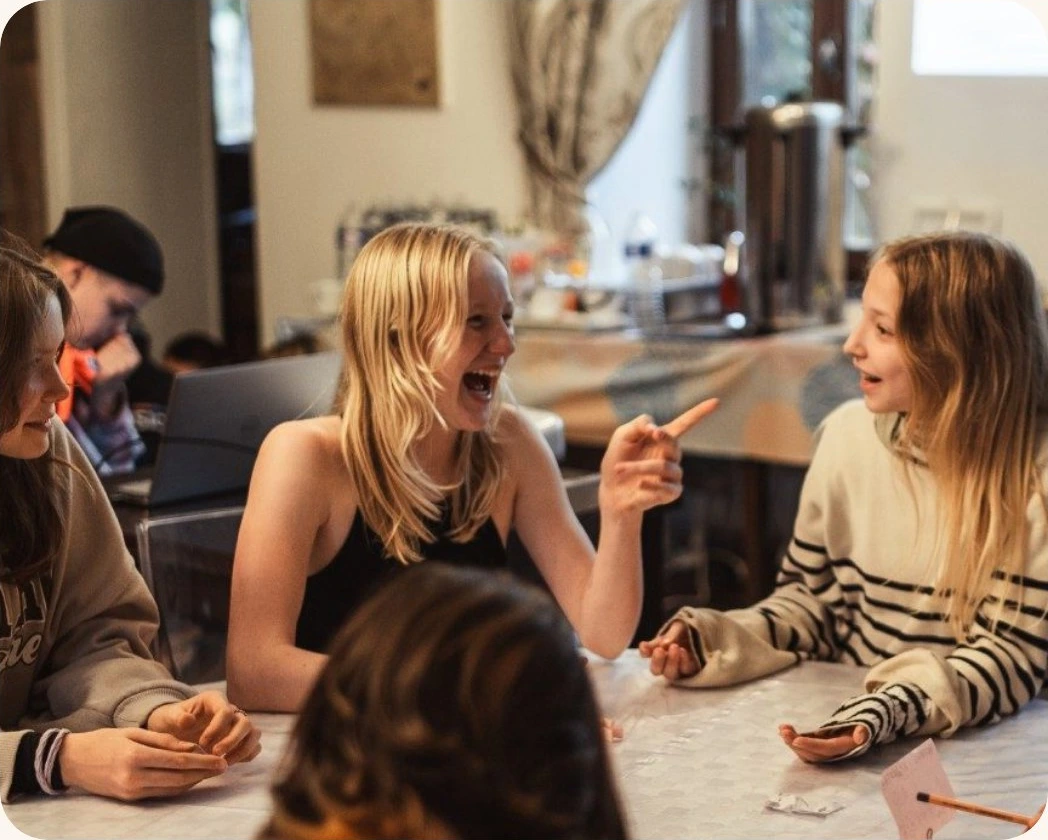
For kids who have decided math is a list of rules to memorize. Here it works more like detective work, and being slow is not the same as being bad at it.
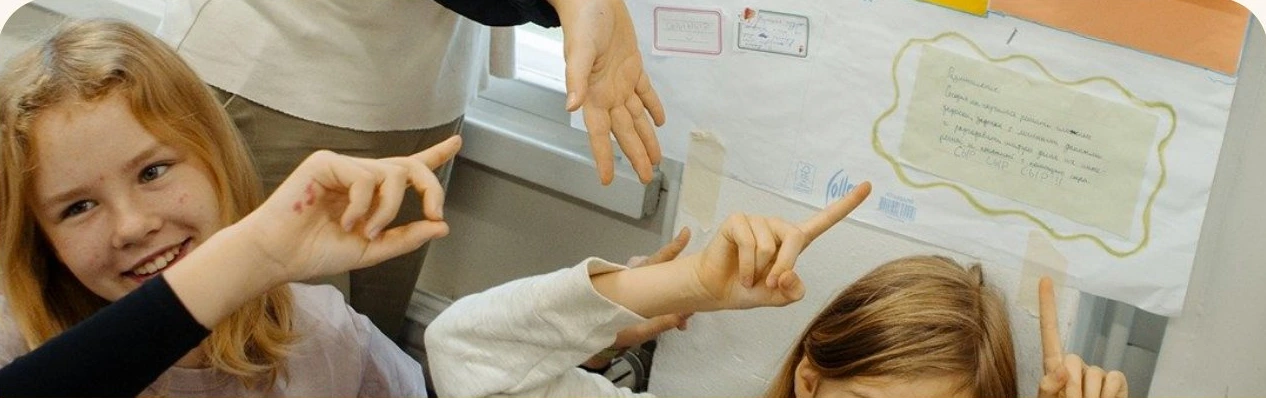
For kids who finish the textbook early and are bored in class. Olympiad problems, proofs, and topics school reaches years later, if at all.
Three levels, formed by the entrance problems rather than by age or school grade. Campers can move between them during the week.

Nothing here needs algebra.
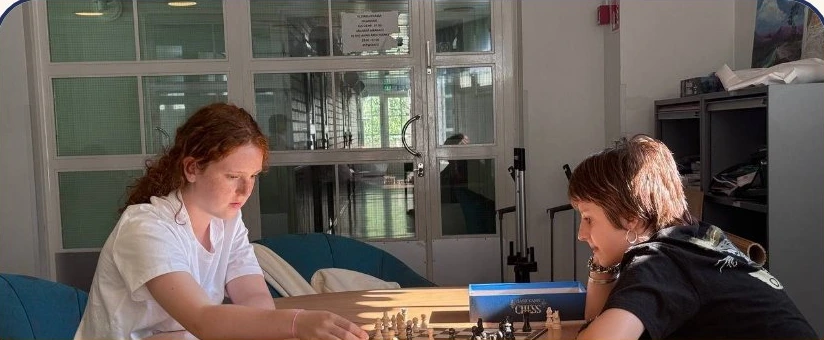
For kids who have never been asked to prove anything.

For kids already solving competition problems.
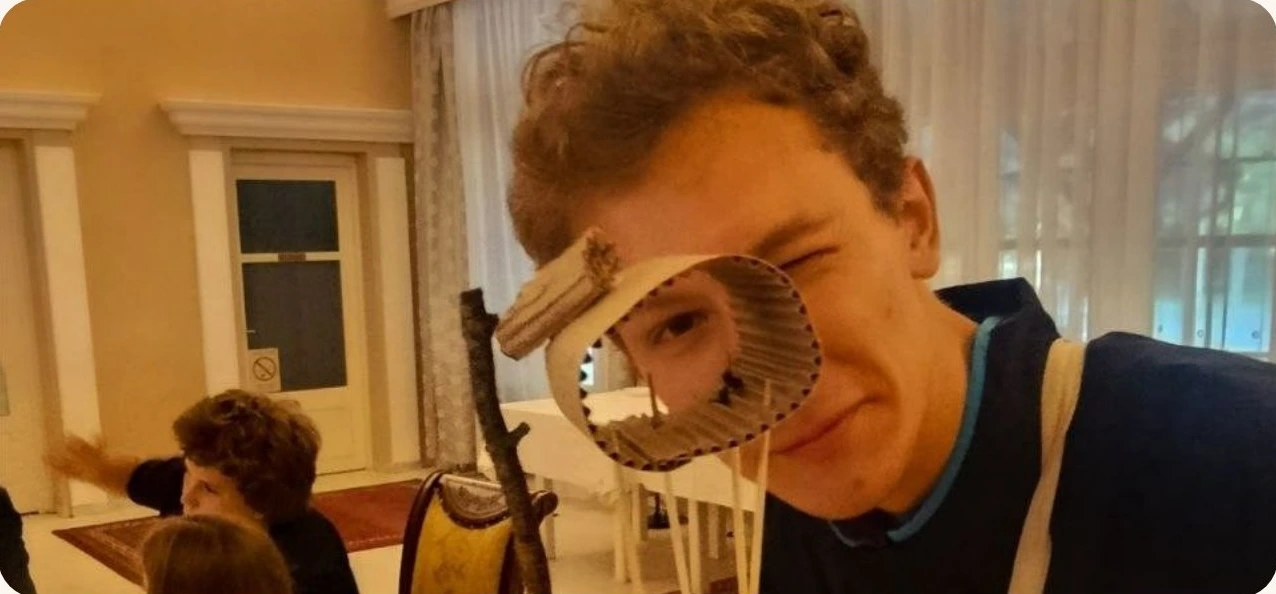
Caesar shifts, frequency analysis, and why multiplying two large primes is easy to do and hard to undo.
Möbius strips cut in halves and thirds, and Euler's V − E + F = 2 tested on everything the group builds.
Expected value by playing, non-transitive dice, and Monty Hall argued out until the room agrees.
Tree heights from shadows, and Eratosthenes' measurement of the Earth repeated at camp scale.
Trisecting an angle by folding: what straightedge and compass cannot do, paper can.
Optional. Past AMC 8 and MATHCOUNTS problems, worked through together, with a plan for the spring.
The week ends with a team math battle: teams present proofs at the board and cross-examine each other's, with teachers as the jury.
Everyone eats together.
In level groups: circles, problems, proofs.
And time outdoors.
Ciphers, topology, games, outdoor math.
Tournaments, films, free time, and the daily phone hour.
Sunday is arrival and placement into groups. Friday is the math battle and the closing party. Saturday, everyone goes home after breakfast.


Every applicant solves three problems at home, with no time limit and no calculator, and sends us what they wrote, including the attempts that failed. We read for how a child thinks, not for correct answers. Solving none of them is not a rejection: it places a camper in Level 1.
A chocolate bar is a 4 × 6 grid of squares. Each snap breaks one piece into two along a line. How many snaps to reduce it to 24 single squares? Does the order change the answer?
Cut two opposite corners off a chessboard. Can the remaining 62 squares be covered by 31 dominoes, each covering two neighbouring squares? Explain why, or why not.
Experienced math teachers, and camp people who have run residential sessions for years. You need both: one group knows how to explain a proof, the other knows how to get eleven-year-olds to bed.
[Where they teach, years of teaching, competition coaching.]
[Where they teach, years of teaching, what they run outside class.]
[Where they teach, years of teaching, camp experience.]
Runs the week: staff, schedule, safety, and the part where everyone actually sleeps.
[Where they teach, years of teaching.]
[Who they are.] They live in the same buildings as the campers.
One adult for every three campers, around the clock.
February 7–13, 2027. One price, paid once. Nothing else to buy during the week.
Apply for a spotOne adult for every three campers. Supervision 24 hours a day, a registered paramedic on site all week, and phones for one hour a day.
“[Camper quote — paste a real one]”
Camper, age 12
“[Parent quote — paste a real one]”
Parent, Marabou camp 2026
“[Teacher quote — paste a real one]”
Math teacher
Classrooms, dining hall, dorms, and trails in the woods of central Massachusetts.
An hour and a half from Boston by car.
Kids who hate math usually hate one version of it: timed drills with one right method. Here there are no grades, no tests, and no speed. Level 1 exists for exactly these campers.
Level 3 explores Olympiad problems, proofs, and topics beyond the school curriculum. Groups are formed by the entrance problems, and campers can move between levels during the week.
There is one adult for every three campers, supervision around the clock, and a registered paramedic on site all week. Campers have their phones for one hour a day.
All meals and snacks are included. Please discuss allergies and dietary needs with the camp team before making a booking.
The camp takes place at Nature's Classroom in Charlton, Massachusetts, around an hour and a half from Boston by car. Travel to and from camp is not included.
The $2,100 fee covers six nights, all meals and snacks, classes, activities, materials, and supervision. Ask the camp team for deposit and instalment details before booking.
Please request the full cancellation and refund terms from the camp team before paying.
Please ask the camp team about availability and eligibility before applying.
Please discuss your family's photo and media preferences with the camp team before arrival.
February 7–13, 2027. $2,100 for the week. Apply and we'll send the entrance problems.